
If you’re organising a Christmas party, you probably want your guests to have a great time. But if you’re responsible for booking the entertainment, there is often another question in the back of your mind:
“Will people actually enjoy this?”
And perhaps more importantly:
“Will they still be talking about it afterwards?”
There are plenty of options for Christmas party entertainment. Live bands, singers, DJs, pianists, quizzes, games, photo booths and performers can all work really well.
But I don’t think the entertainment being unusual automatically makes it memorable.
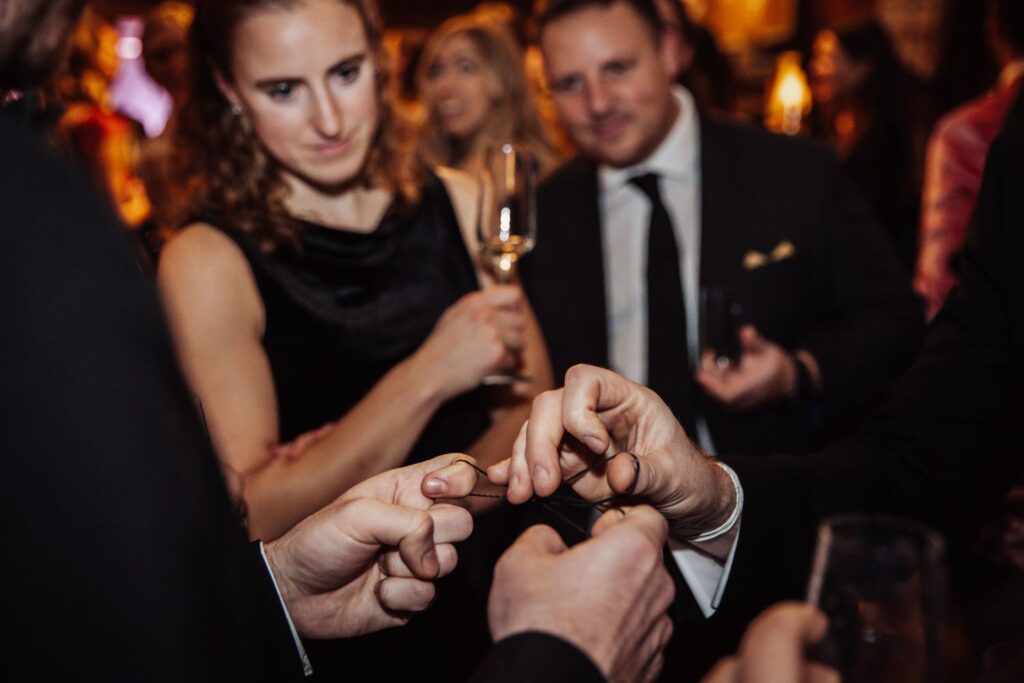
In my experience performing close up magic at corporate events, Christmas parties and private celebrations, the entertainment people remember is usually the entertainment that involves them.
They don’t just watch it. They experience it.
What makes Christmas party entertainment memorable?
The difference between watching a magician perform and actually being part of the magic is where my main focus lies.
A singer, for example, can be brilliant. A pianist can create a fantastic atmosphere. A DJ can get the whole room dancing. But the experience is often still centred around the performer and hearing a familair or favourite song and tune.
With close-up magic at Christmas parties, something different happens.
A guest might choose a card, write a message or name of someone close to them, make a decision or hold something in their own hands. All of a sudden, the magic isn’t something happening to them.
They are now part of it and that gives them a story to tell.
I’ve regularly have guests ask me to perform something again, grab a friend or colleague and say, “You’ve got to see this.”
Sometimes, I glance over and hear guests explaining what happened to other people around the room. That is the bit I think is particularly valuable at a Christmas party.
It's not just about the magic
As the years have passed, I’ve learnt that being a good entertainer is about more than being good at the thing you’re performing.
I think the order is:
Entertainer first. Magician second.
At a corporate Christmas party, people don’t necessarily want to be the centre of attention. They’ve come to have a drink, talk to colleagues and enjoy themselves. So I don’t walk up to somebody and immediately put them on the spot.
I arrive early, introduce myself to the organiser and make sure they know everything is under control. Then I wait for guests to arrive and settle in. I’ll normally start with a small group rather than walking straight into the biggest crowd.
Once a few people have seen something, other guests naturally become interested. Someone will say, “What did he do?” Someone else comes over.
Then it starts to build.
I tend to work around the bar and social areas because that’s where people naturally gather and if someone doesn’t want to participate, that’s completely fine. I don’t make a big deal of it. I’ll simply say no problem, perform for somebody who is more interested.
That matters.
People are much more likely to enjoy entertainment when they feel comfortable rather than feeling they’ve been forced into participating.