
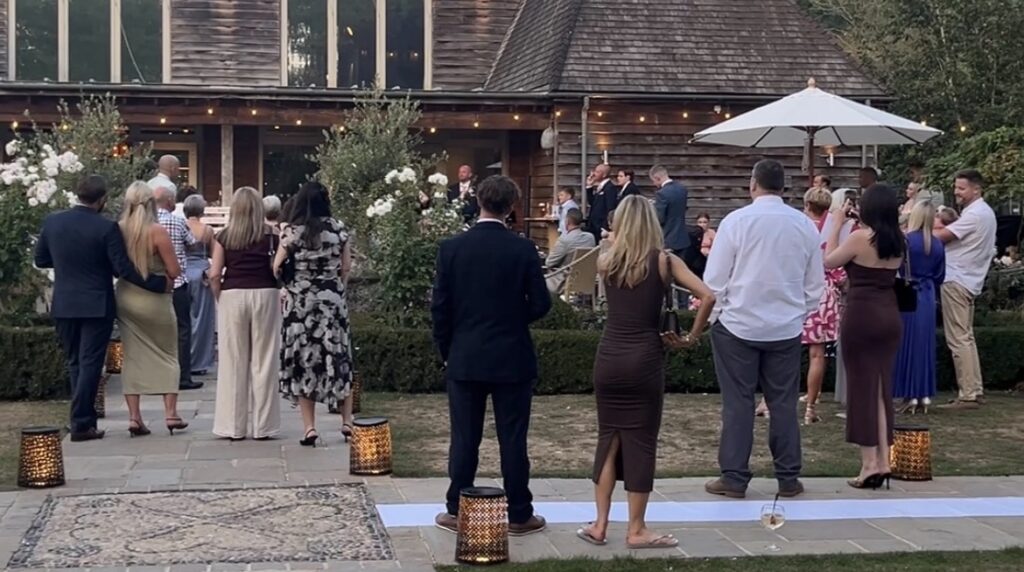
I recently perfomed at a twilight wedding at Houchins in Essex. It was a good example of how close-up magic can be adapted to fit around the wedding schedule or order of events.
With around 130 daytime guests and a further 20 evening guests, I was booked for two hours of close-up magic with a 45-minute break in between.
A twilight wedding has a later start and this allows for a more flexible format, that worked well for this wedding. I could meet guests and perform magic when they had time to enjoy it rather than simply sticking to a timetable.
Magic while guests waited for the BBQ
I started performing at around 6pm, following on from the sax player that had begun at 5.30pm.
This worked nicely because guests could settle in after the ceremony and enjoy the live music first before the magic was introduced, giving the entertainment a natural progression.
As the BBQ food started, I began moving between the groups of guests while they waited.
There was a large family at the wedding, with plenty of cousins and different family groups catching up, so there were lots of natural groups to work with.
I moved between the groups, performing close-up magic while people were enjoying a drink and waiting for food.
It meant the queue and waiting time became part of the entertainment rather than simply time spent waiting for the BBQ.
A birthday surprise for the bride's mum
Unbeknown to me, the bride’s mum’s birthdays happened to fall on the same day as the wedding.
Once I found this out, I was able to quickly adapt one of my routines specifically for her.
I performed this trick just after spending time with the wedding couple for their routine, it was a lovely moment for the bride to watch her mum have a special routine too.
It’s one of the advantages of close-up magic at a wedding. Because I’m working directly with the guests, I can respond to things that happen during the day and create something personal rather than just working through the fixed set of tricks I have.
What happened when the schedule overran?
As with many weddings, the schedule didn’t run exactly to plan.
The formalities took place, including the speeches and first dance, and timings moved around during the day.
That wasn’t a problem.
I don’t work on the basis that a wedding will run perfectly to the minute. I allow for the fact that speeches can overrun, food can take longer than expected and photographs can run late.
It has to be the perfect result for the wedding couple.
For this wedding, that flexibility meant the magic could fit around what was actually happening rather than becoming another thing for the couple to worry about.
Why a split booking can work for a twilight wedding
This wedding was booked as a split two-hour performance with a 45-minute break.
For a twilight wedding, this can be a useful option.
Rather than paying for continuous entertainment when there may be periods where guests are occupied with food, speeches or other formalities, the magic can be placed around the parts of the day where it is most useful.
For larger weddings, this flexibility can also be particularly helpful. With 130 daytime guests and additional evening guests, there were plenty of people to entertain, but the entertainment still needed to work around the wedding itself.
My priority is fitting the magic around the day and helping the couple and their guests enjoy it. That’s why I’m not rigid about watching the clock at weddings.
If you’re planning a wedding in Essex and want close-up magic that can work around your timings rather than dictate them,